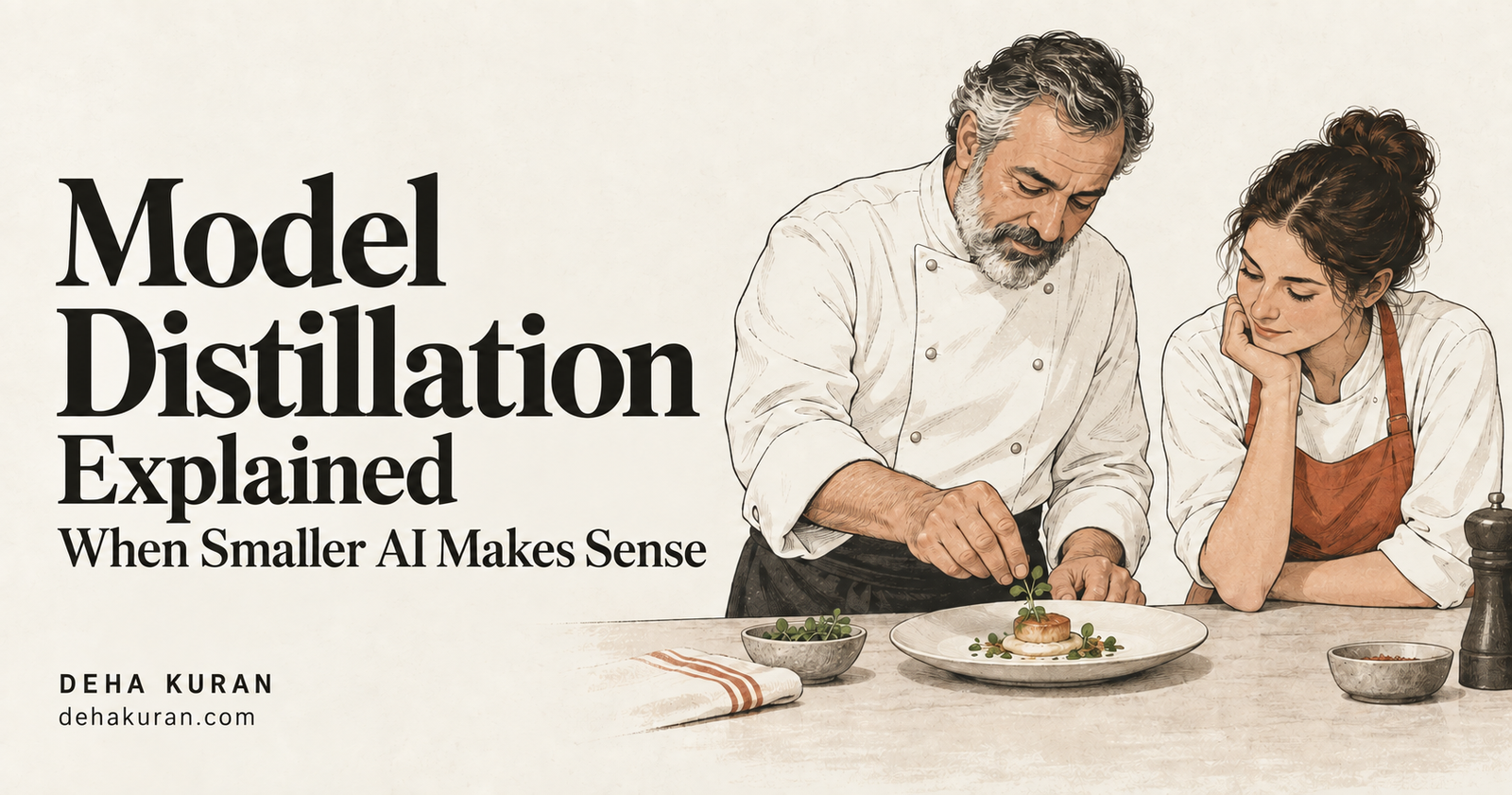
Imagine an experienced chef teaching an apprentice to prepare five popular dishes. The apprentice does not acquire the chef’s entire expertise. But with good examples, practice, and feedback, they can learn to prepare those dishes reliably without the chef supervising every plate.
Model distillation applies a similar idea to artificial intelligence. A capable AI—the teacher—helps train another, usually smaller model—the student. The aim is to teach useful abilities while reducing the computing power needed to use them.
The apprentice will still struggle with an unfamiliar recipe. Likewise, a distilled model is not a perfect miniature of its teacher. Its value depends on how well it handles the work we actually need.
Consider a repair company receiving hundreds of customer messages every day.
One customer writes: “The drum vibrates excessively during the spin cycle.”
Another says: “My washing machine sounds like a helicopter taking off, and now there’s water underneath.”
Someone must turn these descriptions into service requests: which appliance, what symptoms, and what information is missing. AI can help interpret the different ways people describe a problem.
If everyone filled out a structured form, conventional software could route the requests. But real messages contain slang, spelling mistakes, several problems at once, and incomplete explanations. Writing a rule for every variation quickly becomes difficult.
This is where distillation could make sense.
The company could first use a powerful model to help produce examples of well-organized service requests. Staff would check those examples, and developers would use them to train a smaller model. They would then test it on messages it had never seen.
The smaller model’s job would be limited: extract the symptoms and identify missing details. Ordinary software would check appointment availability, and staff would handle uncertain cases.
You need the head chef to develop and teach the menu. You may not need them preparing every order.
The potential saving comes from repetition. If the smaller model processes thousands of messages adequately at a lower running cost, the investment in training can pay off. For a business receiving five messages a week, that investment may make little sense.
Distillation has existed for years. A landmark paper appeared in 2015, building on earlier research. What has improved is access to capable models and tools that connect example collection, training, and testing. Developers have less infrastructure to assemble themselves. Original research, an example of integrated tooling.
Teaching methods are improving, too. Rather than only copying polished answers, a student can attempt a task and receive detailed feedback from its teacher. Thinking Machines Lab reported efficiency gains from this approach in its 2025 experiments. It resembles the chef correcting the apprentice’s technique during practice. Research details.
In 2026, NVIDIA also demonstrated how distillation can help compressed models recover accuracy lost when their internal numbers are stored less precisely. That offers another route to reducing computing requirements while preserving useful performance. NVIDIA’s report.
The compromises still matter. Students can inherit mistakes, miss unusual cases, or sound confident while being wrong. Training, maintenance, and correcting failures cost money. A lower computing bill alone does not prove better value.
For the repair company, success would mean less time organizing messages without more errors or missed details. That needs measurement, not assumptions.
Most everyday users will benefit through the services they use rather than training models themselves. The guiding question is simple: can a smaller, carefully taught system do this useful job reliably enough to justify its cost?