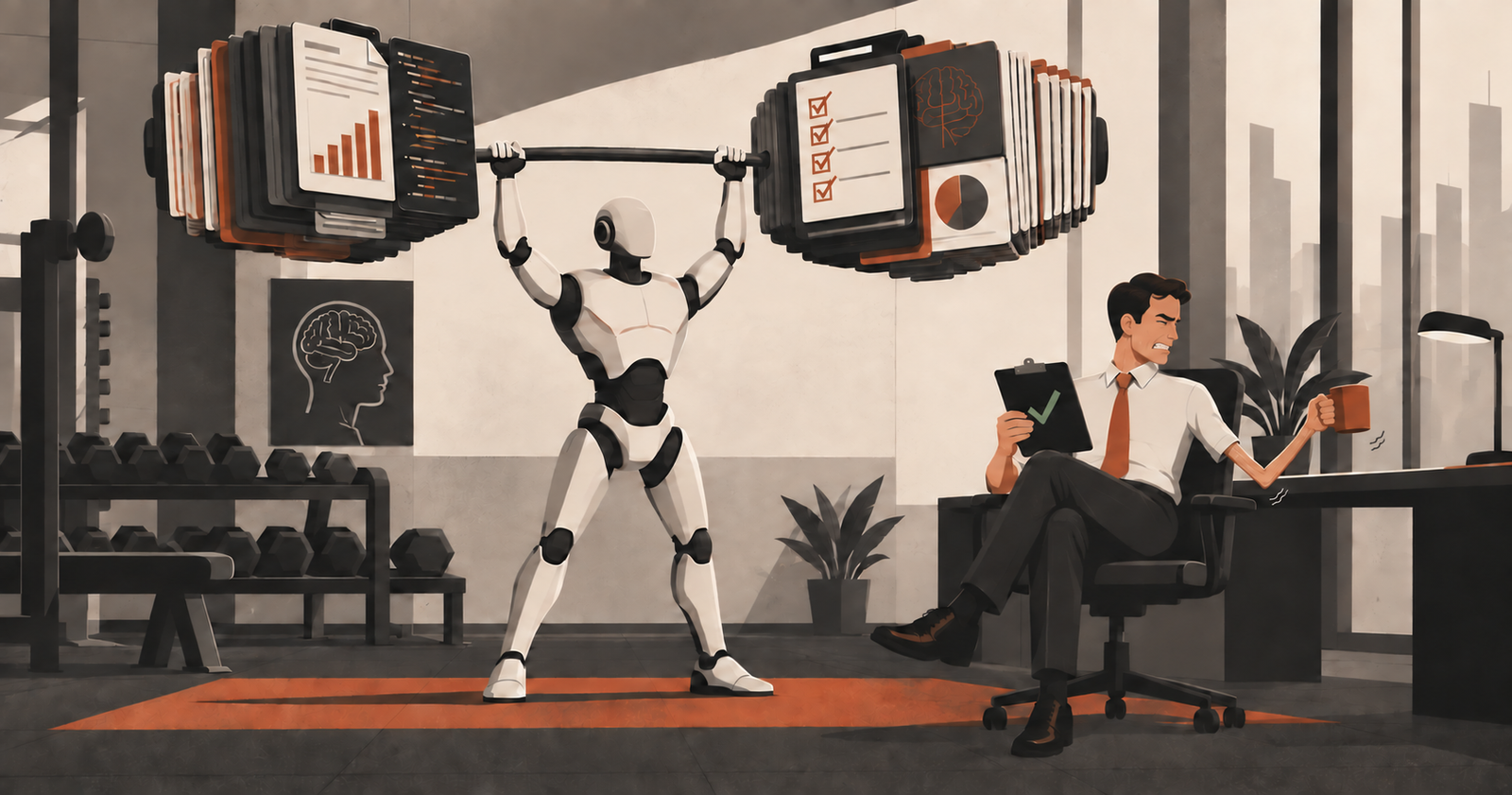
In 2026, AI is no longer waiting at the edge of knowledge work. It is drafting the first version, summarising the source material, proposing the decision and preparing the response.
The immediate result can be impressive. More output. Shorter cycle times. Work that once required specialist help is now completed by a generalist with an agent.
But most organisations measure what the system produces today. They do not measure what their people may no longer be able to do tomorrow.
That is skill atrophy: capability weakening through disuse. It does not arrive as a visible failure. It appears first as convenience.
“A company can become more productive this quarter while becoming less capable of recovering when the machine is wrong.”
I wrote earlier about the skill erosion paradox in software engineering: the better AI becomes at producing code, the more valuable deep engineering skill becomes for judging it. The evidence emerging in 2026 makes the issue broader. Skill atrophy is becoming an enterprise operating risk.
Output is not capability
A completed task proves that the combined human-and-AI system produced an answer. It does not prove that the human understood the answer, could reproduce the reasoning or would recognise when the same approach fails under different conditions.
Anthropic tested this distinction in a randomised study of 52 mostly junior software engineers learning an unfamiliar Python library. The AI-assisted group completed the task only about two minutes faster, a difference that was not statistically significant. On the subsequent mastery test, however, they averaged 50%, compared with 67% for the group that coded by hand. The largest gap appeared in debugging: the skill needed to identify why generated code is wrong. Read the Anthropic study.
This was a small study of one coding task, not a verdict on every use of AI. Its value is that it separated task completion from skill formation. Those are different outcomes, yet enterprise dashboards routinely count only the first.
The pattern is not confined to programming. Microsoft Research surveyed 319 knowledge workers and collected 936 examples of AI use at work. Higher confidence in AI was associated with less critical thinking, while higher confidence in one’s own ability was associated with more. The work did not disappear; it shifted from producing an answer to verifying, integrating and stewarding an answer generated elsewhere. Read the Microsoft Research study.
That shift sounds like progress. Often it is. But verification is not a lightweight substitute for expertise. To know that an answer is subtly wrong, a person still needs a working model of what right looks like.
The danger is delayed
Ordinary quality controls are good at finding visible defects. Skill atrophy is harder because the output can remain acceptable while the underlying human capability declines.
A 2026 CHI paper reported findings from a year-long study of AI use among cancer specialists. Early operational gains concealed what the researchers called “intuition rust”: a gradual dulling of expert judgment that could later develop into skill atrophy. The term matters because intuition in expert work is not instinct detached from evidence. It is compressed experience: the capacity to notice that a case does not fit the expected pattern. Read the CHI 2026 paper.
When AI handles the routine cases, humans may receive fewer repetitions from which expertise is built. At the same time, the cases that reach them become more exceptional. We are removing the practice and raising the difficulty together.
This creates a dangerous delay between cause and consequence. A team can use AI successfully for months before discovering that nobody remembers how to investigate a failure without it. A junior employee can look productive while missing the difficult repetitions that used to build senior judgment. A manager can approve more work while becoming less able to challenge the assumptions inside it.
By the time the weakness appears in a business metric, the organisation may already have lost the people, practice and confidence needed to recover.
The apprenticeship ladder is being shortened
Every profession has work that looks inefficient when viewed one task at a time. A junior analyst reconciles inconsistent data. A new engineer traces a defect through an unfamiliar system. A clinician reviews ordinary cases before seeing rare ones. An editor rewrites weak paragraphs.
These tasks produce deliverables. They also produce practitioners.
If AI absorbs the work at the bottom of the ladder, organisations cannot assume expertise will still appear at the top. Senior judgment is not downloaded with a promotion. It is formed through exposure, error, correction and explanation.
The OECD reviewed evidence showing why the distinction matters. In one field experiment involving almost 1,000 students, access to generative AI improved performance while the tool was available. When access was removed, those students performed 17% worse than students who had never used it. In a separate trial with employees learning data-science tasks, AI access improved task performance but did not produce better technical knowledge afterward. Read the OECD review.
Again, the conclusion is not that AI prevents learning. Anthropic’s study found that stronger performers used AI to build comprehension: they asked for explanations, followed up and tested concepts themselves. The tool can be a tutor or an answer machine. Workflow design determines which one employees receive.
Treat human capability as infrastructure
Most enterprise AI policies focus on data, security, accuracy and acceptable use. They should. But an organisation that protects the model and not the capability of the people around it is protecting only half the system.
Leaders need a capability budget alongside the productivity business case. That means deciding which skills may safely fade, which must remain available and which new skills must be built because the human role has changed.
Four practices can make that concrete:
- Define the minimum human capability. For each AI-supported workflow, identify what people must still be able to understand, challenge and perform when the system is unavailable or wrong.
- Preserve deliberate practice. Keep selected tasks, simulations and failure drills human-led. Efficiency is not the goal of a drill; retained competence is.
- Measure learning separately from output. Track whether employees can explain decisions, diagnose failures and transfer knowledge to a new case—not only how quickly they complete the assisted task.
- Make AI teach before it tells. Use interaction patterns that expose assumptions, ask the user to predict, offer alternatives and explain trade-offs before producing the final answer.
This is not an argument for ceremonial manual work. Calculators did not require every accountant to keep practising long division. The point is to preserve the capabilities on which safety, adaptation and accountability still depend.
That boundary will differ by role. A communications team may no longer need everyone to produce a first draft from a blank page, but it still needs people who can identify a false claim and defend an editorial choice. An engineering team may delegate syntax while retaining architecture, debugging and systems reasoning. A clinical workflow may automate documentation while protecting diagnostic judgment and escalation skills.
The question for 2026
Organisations have spent the first years of generative AI asking where the technology can save time. The next question is more difficult: what must humans continue to practise even when the machine can do it faster?
There is no virtue in preserving every old task. There is also no resilience in allowing essential judgment to decay because its loss is absent from the quarterly dashboard.
AI adoption should leave an organisation more capable, not merely more productive. If a system increases output while weakening the people responsible for its consequences, the efficiency gain is borrowing against future competence.
In 2026, that debt is becoming visible. Leaders should start accounting for it.